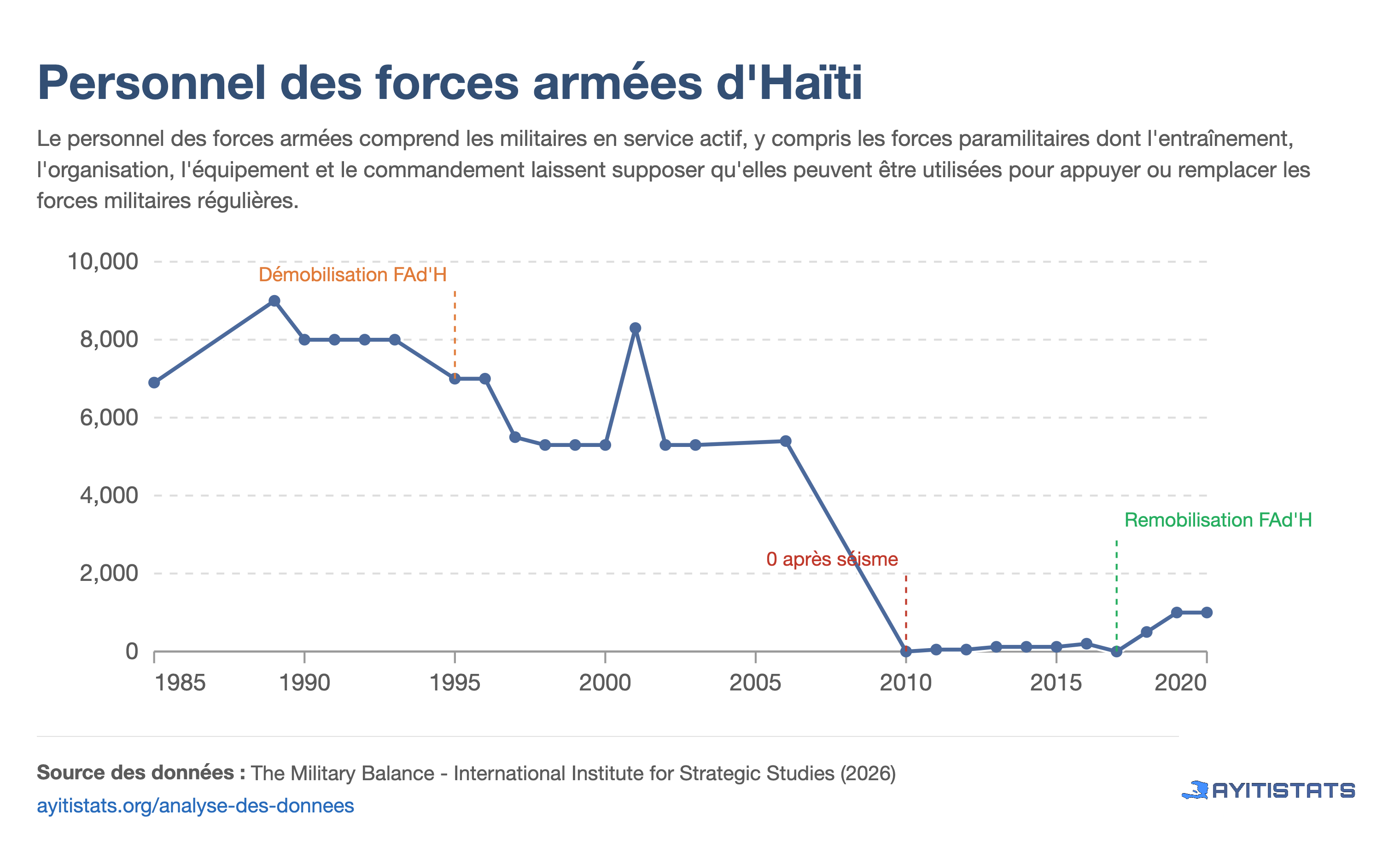
Military personnel refers to all active-duty service members, including certain paramilitary forces capable of supporting or replacing the regular army.
In 1989, the country had approximately 9,000 active soldiers. Two years later, President Jean-Bertrand Aristide was overthrown in a military coup, just seven months after taking power. Upon his return from exile in 1995, he officially demobilized the Forces Armées d'Haïti (FADH), an institution marked by decades of abuses and political interference. The resulting security vacuum was filled by the National Police and international forces, notably MINUSTAH, a UN mission present for 13 years.
In 2010, a devastating earthquake struck Haiti. Amid the chaos, the last remaining elements of the former forces disappeared from the records, and the indicator officially dropped to zero.
Then in 2017, as the Blue Helmets prepared to leave the country, Haiti began rebuilding its army: 500 recruits, aged 18 to 25, selected through a competitive process in Léogâne. Idle youth, in a country plagued by endemic unemployment, who saw in this an opportunity to serve their nation.
By 2020, the Haitian army had reached 1,000 soldiers, a figure still largely symbolic in the face of today's security challenges.
Source: The Military Balance — International Institute for Strategic Studies (2026), World Bank. Data processed and visualized by Ayitistats.